

7 common Google Ads mistakes for webshops (and how to avoid them)
Put Google Ads to work effectively. Curious about the mistakes we see most often? Read all about it in our new blog.
Campaigns
Google, Meta and LinkedIn, steered by a specialist.
Findability
Being found in Google and in ChatGPT, Perplexity and Gemini.
Websites and software
Websites, webshops and software on Webflow, EmDash or Medusa.
AI and automation
AI applications and automations that take work off your hands.
More and more businesses are discovering the power of AI in their campaigns. Not only because it saves time, but mainly because it brings new insights and contributes to better performance. This blog shows how AI can play a valuable role in every part of Google Ads, from strategy to optimisation.
Online advertising is a dynamic trade. In a world where the market keeps changing, platforms adjust their algorithms and user behaviour is ever harder to predict, manual campaign management can quickly fall short. At the same time, AI is now here. Not as a hype, but as a serious tool to work smarter and faster within the Google Ads ecosystem.
More and more businesses are discovering the power of AI in their campaigns. Not only because it saves time, but mainly because it brings new insights and contributes to better performance. This blog shows how AI can play a valuable role in every part of Google Ads, from strategy to optimisation.
Many advertisers already use AI without being fully aware of it. Bidding strategies such as ‘Maximise conversions’ or ‘Target ROAS’ are based on machine learning. They automatically analyse millions of signals to determine which bid is most promising at which moment. This is done on the basis of data such as location, device, time of day, search history and more. Ad extensions and responsive ads are also partly generated or optimised automatically on the basis of historical performance.
With the arrival of Performance Max (PMax), that automation has increased further. Google decides for itself where ads are shown, on which channel and with which combination of headlines, descriptions and visuals. Everything is driven by an algorithm that keeps learning from the results.
Still, this is only the beginning. Because outside the Google interface itself, there are many more opportunities to use AI smartly.
Where Google focuses on automating processes within its own system, you can use AI yourself to set up everything around it more smartly. Think of generating ad texts, improving product feeds or analysing campaign results. Tools such as ChatGPT make it possible to develop ideas for headlines, calls to action and ad content faster, tailored to specific audiences or segments.
Suppose, for example, that a webshop has 1,000 products, spread over dozens of categories. Optimising titles for Google Shopping by hand is an enormous job. But with AI tools you can rewrite product descriptions, enrich titles with keywords and bring consistency to the structure of your feed. Tools such as Channable also offer integrations that bring AI directly into feed management.
AI can help at a strategic level too. Analysing search terms, discovering new opportunities within your market or simulating customer behaviour are applications that are used more and more often. You could, for example, ask AI to carry out an audit of your current ads: which terms come up often? Where are the gaps in your targeting? How does your ad stand out from the competition?
The main benefit of AI is the speed at which you get results. Campaigns that used to take hours to set up can now be live in a fraction of that time. AI also helps to identify optimisation opportunities that you, as a human, might overlook. Think of subtle patterns in conversion behaviour or recurring mistakes in ad texts.
AI also contributes to consistency. Where manual campaigns are often influenced by preferences, assumptions or limited attention, AI works on logic and data. That leads to more stable results and makes it easier to monitor performance over a longer period.
Another benefit is scalability. For businesses that manage several campaigns or operate in several countries, it is almost impossible to keep track of everything by hand. AI makes it possible to process larger amounts of data and take targeted action on that basis. That applies not only to big players, but especially to ambitious e-commerce businesses that want to scale up.
Still, AI is not a cure-all. Relying too much on automation without good control mechanisms can lead to poor results. Performance Max is a good example of this. Although the campaign type offers powerful possibilities, it is also a black box: you can't see exactly where your ads are shown, on which keywords or through which channel. That makes it hard to steer or to learn from the data.
Automatically generated texts are not always optimal either. AI can write copy perfectly well, but doesn't always understand your brand's tone of voice, the sensitivities within an industry or the exact nuance needed to convince a visitor. Keeping control over the content therefore remains essential.
In addition, many AI applications depend heavily on the quality of your input. If you supply incomplete or incorrect data, the AI includes it in its calculations, with all the consequences that brings. Think of wrongly set up conversions, missing product information or wrong audiences.
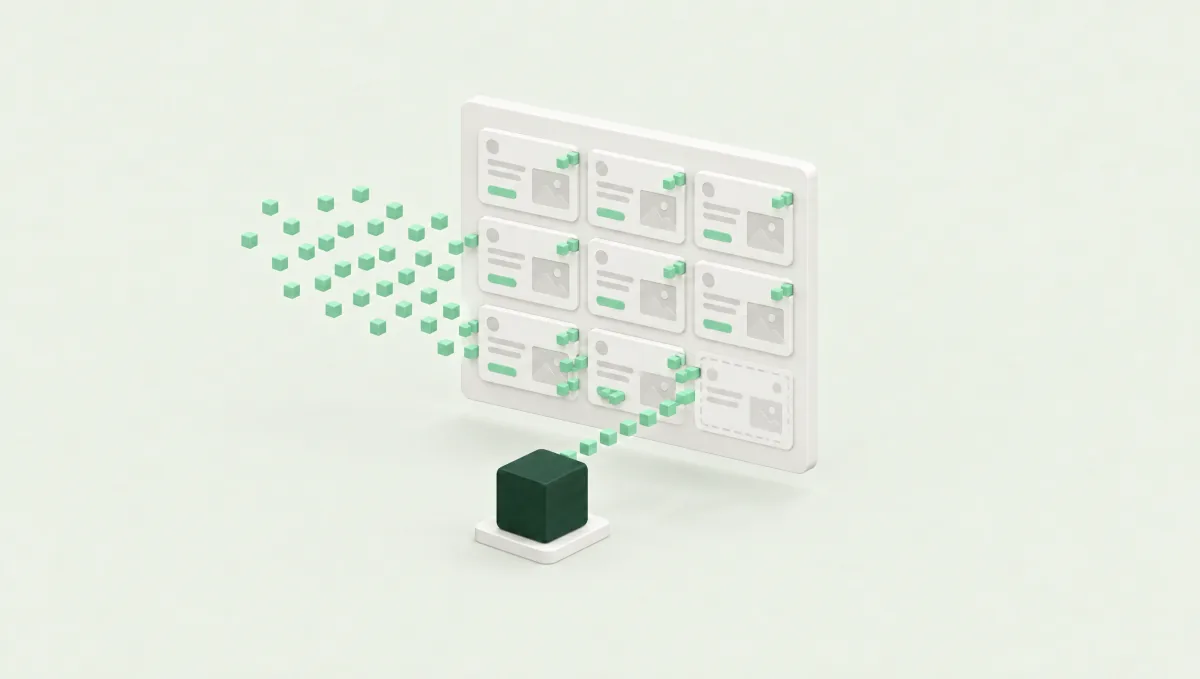
A concrete example where AI adds value straight away is feed optimisation. For e-commerce businesses, the product feed is an essential part of success in Google Shopping. The title, description, price, availability and category largely determine both visibility and click-through rate.
AI can be used to enrich product titles automatically with relevant keywords. This is done on the basis of market data, competitor analyses and best practices. Descriptions can be rewritten to fit search intent better or to avoid duplicate content. AI can also make recommendations for categories, tags or extra attributes.
These optimisations raise not only relevance, but often the conversion rate too. And all of that without having to adjust hundreds of products by hand.
The key to success lies in the right balance. AI is extremely well suited to repetitive tasks, processing large amounts of data and discovering patterns. But strategy, creativity and interpretation remain human work. Especially when setting up campaigns, writing convincing copy or building a brand, human direction is indispensable.
That is why it is wise to use AI as an accelerator, not as a replacement. Use it to generate ideas, analyse data and streamline processes, but always stay in charge. Make choices consciously, adjust on the basis of insights and stay critical about what your tools are actually doing.

AI has fundamentally changed the way Google Ads is used. What began as a tool for better bidding strategies has grown into a full assistant in content creation, data comparison and feed optimisation. The gain is not only in time saved, but above all in smarter campaigns, better performance and scalable growth.
For businesses that want to get serious about their online visibility, it is therefore not a question of whether you should use AI, but how you do it in a controlled and strategic way. Those who find that balance reap the rewards of more efficient campaigns and better results. And all that without losing control.
Put Google Ads to work effectively. Curious about the mistakes we see most often? Read all about it in our new blog.
The PMax campaign gives you little insight. Still, there is a lot you can keep adjusting yourself to improve the results.
Running Google Ads involves a lot. Not just the ad budget, but of course the return too. How do you decide what is good and what is bad?
In 30 minutes we look at your current approach: website, campaigns and findability as one whole. You talk directly to a specialist, not an account manager.
Or get in touch directly: info@talkpixels.nl 085 - 06 01 201
We'd love to remember your preferences. You decide which cookies are okay.
We use cookies to improve your experience. Choose which categories you allow. You can change this at any time.